

10th Special Forces "The Originals" Horse Skull Patch 3 3/4" with Hook & Loop
10th Special Forces "The Originals" Horse Skull Patch 3 3/4" with Hook & Loop
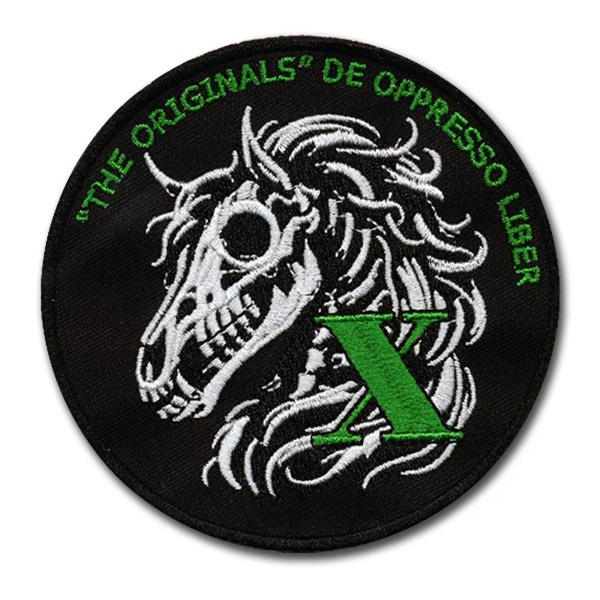


10th Special Forces "The Originals" Horse Skull Patch 3 3/4" with Hook & Loop
10th Special Forces "The Originals" Horse Skull Patch 3 3/4" with Hook & Loop
The 10th Special Forces Group (Airborne) (10th SFG (A), or 10th Group) is an active duty United States Army Special Forces (SF) Group. 10th Group is designed to deploy and execute nine doctrinal missions: unconventional warfare, foreign internal defense, direct action, counterinsurgency, special reconnaissance, counterterrorism, information operations, counter-proliferation of weapon of mass destruction, and security force assistance. 10th Group is responsible for operations within the EUCOM area of responsibility, as part of Special Operations Command Europe (SOCEUR).
In 2009, as part of a new SOCOM directive, the group is now also responsible for operations within the AFRICOM area of responsibility. 10th SFG(A) was deployed to Saudi Arabia in 1991 during the First Persian Gulf War, and has been heavily involved in the War on Terrorism, deploying to Georgia, North Africa, Afghanistan, and consistently to Iraq.
Creation
The 10th Special Forces Group (Airborne) Headquarters and Headquarters Company (HHC) was activated on 19 May 1952 and 10th SFG was activated on 19 June 1952, at Fort Bragg, North Carolina, under the command of Colonel Aaron Bank.
The first Special Forces Course graduated in 1952 and the Group grew to 1,700 personnel. In September 1953, 782 members of the Group deployed to Germany and established the Group headquarters at Lengries in Bavaria. An additional 99 personnel deployed to Korea where they were assigned to the 8240th Army Unit which was training anti-Communist North Korean partisans on the off-shore islands. The remaining personnel stayed at Fort Bragg where they formed the 77th Special Forces Group (redesignated as the 7th SFG in 1960). In 1968, the majority of the unit transferred to Fort Devens, Massachusetts, with the exception of 1st Battalion, which remained in Germany. Between 1994 and 1995, 10th SFG(A) moved to Fort Carson, Colorado, which remains its current home.
10th Group began training with unconventional warfare groups from friendly countries in the 1960s, beginning with NATO allies. The group has also trained various components of the militaries of several Middle Eastern countries, including Lebanon, Jordan, Yemen, Iran, as well as Kurdish tribesmen. Units of the 10th SFG(A) have participated in humanitarian missions to the Congo, Somalia, and Rwanda.
History
1950s
In 1950, the Lodge Act was passed, which provided for the recruiting of foreign nationals into the United States military. It was originally planned that half of the members of the Special Forces would be native Europeans. Many of the initial members of the 10th SFG(A) were Lodge Act recruits, who were strenuously anti-Communist. Among the more notable of these men was Major Larry Thorne, a former Finnish Army soldier who was awarded the Mannerheim Cross during World War II.
The 10th SFG(A) was constituted 19 May 1952 and activated on 11 June 1952, at Fort Bragg, North Carolina, under the command of Colonel Aaron Bank. The group was split in 1953, with one half being sent to Germany, while the other half remained at Fort Bragg to form the core of the 77th Special Forces Group (redesignated as the 7th SFG in 1960). By the end of June 1952, the group had 122 officers and men assigned. Many had been OSS, Ranger, and Airborne troopers during World War II. The group's mission was to conduct partisan warfare behind Soviet lines in the event of a Soviet invasion of Europe.
On 10 November 1953, the 10th SFG(A) was split in half, with one half deployed to Bad Tölz and Lenggries in West Germany, and the other remaining in Fort Bragg to become the 77th Special Forces Group (which in 1960 became the 7th Special Forces Group). The green beret was authorized for wear by Col. William E. Ekman, the group commander, in 1954, and it became group policy. By 1955, every soldier in the unit wore a green beret as part of the uniform. However, the Department of the Army (DA) did not recognize the beret as headgear. The DA banned the wear of the beret, but in 1961 it was restored by President Kennedy, a major champion of the Special Forces. The 10th Group encountered publicity for the first time in 1955 when The New York Times published two articles about the unit, describing them as a "liberation" force designed to fight behind enemy lines. Pictures showed soldiers of the group wearing their berets, with their faces blacked out to conceal their identities.
1960s
As the United States became increasingly involved in Vietnam, counter-insurgency became the primary focus of the Special Forces, rather than the traditional unconventional warfare. While the 10th SFG(A) was never deployed to Vietnam, the soldiers and officers assigned to it did rotate through the country as part of different special forces groups. During the Vietnam War, detachments of 10th Group began training Middle Eastern special warfare forces. In Jordan, B Detachment established the first airborne school, and King Hussein attended the graduation parachute jump. In 1963, Company C of 10th Group trained 350 officers and NCOs of a guerrilla force fighting the socialist government in Yemen. Detachments also traveled to Iran to train the Iranian Special Forces, along with Kurdish tribesmen in the mountains of Iran. A-Teams also trained Turkish and Pakistani special forces. In 1968, 10th Group, minus the 1st Battalion, was transferred to Fort Devens, Massachusetts. 1st Battalion remained in Bad Tölz, Germany.
1970s – 1980s
Following the military cuts after the end of the Vietnam War, operational deployments decreased in both number and frequency. However 10th Group still deployed frequently to Europe to train with NATO allies. From 11 May 1983 to 25 October 1985, 10th Group deployed 17 Mobile Training Teams (MTT) to Lebanon, to support the Lebanese Army. The teams created a training program for over 5,000 officers, NCOs, and soldiers, which included basic training sites, unit training, unit combined arms live fire training, and urban live fire training. The entry of the Syrian Army into Lebanon ended the program prematurely. An MTT from the 1st Battalion, Bad Tölz, Germany deployed to Somalia for four months to conduct disaster relief operations in June 1985. In 1986, a detachment of 10th Group trained the nucleus of the Nigerian Airborne forces.
1990s – 2000s
Following the Iraqi invasion of Kuwait, an MTT deployed to Kuwait to train the Saudi Arabian National Guard. During the Battle of Khafji, the MTT accompanied the SANG forces into battle, coordinated troop movements, called in airstrikes, and assisted with artillery fire support. Other elements of 10th Group deployed to southeast Turkey in support of operations Desert Shield/Desert Storm. The Boston Herald reported: "The 10th Special Forces Group's penchant for secrecy is so exacting the base publicist didn't know the unit had gone to war until they were on their way home from Operation Desert Storm." Following the end of the Gulf War, Saddam Hussein turned his attention to Iraq's Kurdish minority, causing over half of a million Kurds to flee into the mountains on the Turkish-Iraqi border. Under the leadership of Colonel William Tangney, all three battalions of 10th Group were deployed to the area for Operation Provide Comfort, a UN humanitarian effort. 10th Group coordinated the ground relief effort, and was credited by General Galvin, the EUCOM commander, as having "saved half a million Kurds from extinction".
During Operation Restore Hope, 10th Group deployed a Coalition Support Team to support the 1st Belgian Para-Commando Battalion. In addition to supporting the Para-Commando unit, the CST assisted the 10th Mountain Division, and provided security for meetings with Somali leaders. Following the ethnic conflict in Rwanda, 10th Group deployed to Entebbe airfield, Uganda. The group assisted the displaced persons in returning to their homes.
On 2 September 1994, 2nd Battalion, 10th SFG(A) transferred to Fort Carson, Colorado, followed by 3rd Battalion on 20 July 1995. The group headquarters moved to Fort Carson on 15 September 1995, ending a 27-year presence in Massachusetts. Affiliated for operations with Special Operations Command – Europe, 10th Group is continuing to conduct Joint Combined Exchange Training and FID/anti-terrorist operations as part of Operation Enduring Freedom – Trans Sahara. Such activities have included training the Military of Mali and the Military of Mauritania. The 1st and 3rd Battalions of 10th Group also participated in training in Senegal in 2006, along with the 352d Special Operations Group of the US Air Force. 10th SFG(A) has also deployed numerous times in support of Operation Enduring Freedom and Operation Iraqi Freedom, but mostly to Iraq, since the start of the War on Terrorism. 10th SFG(A) and CIA's Special Activities Division Paramilitary Officers were the first to enter Iraq prior to the invasion. They organized the Kurdish Peshmerga to defeat Ansar al-Islam, an ally of al-Qa'ida, for control of a territory in Northeastern Iraq that was completely under Ansar al-Islam's control. This battle, one of the most important engagements for Special Forces since Vietnam, led to the elimination of a substantial number of terrorists and the discovery of a chemical weapons facility at Sargat (the only facility of its type discovered in the Iraq war). Three Silver Stars and six Bronze Stars for valor were conferred for this engagement. These terrorists would have been part of the subsequent insurgency had they not been eliminated during this battle, which could be called the Tora Bora of Iraq. While several key leaders escaped into Iran, it was a sound defeat for al-Qaeda and Ansar al-Islam. The Americans then led the Peshmerga against Saddam's northern Army. This effort kept Saddam's forces, including 13 Armored Divisions, in the north and denied them the ability to redeploy to contest the invasion force coming from the south. This effort likely saved the lives of hundreds, if not thousands, of coalition service members.
| Isin: | IED42GQHBVYI |
|---|
Out of Stock
In Stock
Backordered
Out of Stock



IBspot Buyer Protection
Shop confidently on IBspot, receive your item as described or your money back for eligible orders. Learn Program Terms
GUARANTEED SAFE CHECKOUT
-

MONEY BACK GUARANTEE
30 days money back guarantee, no additional fee charged.
-

EXCELLENT SUPPORT
We provide 24/7 online customer support via email.
-

Fast Shipping
One week domestic shipping. Global delivery to the US in 2 weeks.
10th Special Forces "The Originals" Horse Skull Patch 3 3/4" with Hook & Loop
The 10th Special Forces Group (Airborne) (10th SFG (A), or 10th Group) is an active duty United States Army Special Forces (SF) Group. 10th Group is designed to deploy and execute nine doctrinal missions: unconventional warfare, foreign internal defense, direct action, counterinsurgency, special reconnaissance, counterterrorism, information operations, counter-proliferation of weapon of mass destruction, and security force assistance. 10th Group is responsible for operations within the EUCOM area of responsibility, as part of Special Operations Command Europe (SOCEUR).
In 2009, as part of a new SOCOM directive, the group is now also responsible for operations within the AFRICOM area of responsibility. 10th SFG(A) was deployed to Saudi Arabia in 1991 during the First Persian Gulf War, and has been heavily involved in the War on Terrorism, deploying to Georgia, North Africa, Afghanistan, and consistently to Iraq.
Creation
The 10th Special Forces Group (Airborne) Headquarters and Headquarters Company (HHC) was activated on 19 May 1952 and 10th SFG was activated on 19 June 1952, at Fort Bragg, North Carolina, under the command of Colonel Aaron Bank.
The first Special Forces Course graduated in 1952 and the Group grew to 1,700 personnel. In September 1953, 782 members of the Group deployed to Germany and established the Group headquarters at Lengries in Bavaria. An additional 99 personnel deployed to Korea where they were assigned to the 8240th Army Unit which was training anti-Communist North Korean partisans on the off-shore islands. The remaining personnel stayed at Fort Bragg where they formed the 77th Special Forces Group (redesignated as the 7th SFG in 1960). In 1968, the majority of the unit transferred to Fort Devens, Massachusetts, with the exception of 1st Battalion, which remained in Germany. Between 1994 and 1995, 10th SFG(A) moved to Fort Carson, Colorado, which remains its current home.
10th Group began training with unconventional warfare groups from friendly countries in the 1960s, beginning with NATO allies. The group has also trained various components of the militaries of several Middle Eastern countries, including Lebanon, Jordan, Yemen, Iran, as well as Kurdish tribesmen. Units of the 10th SFG(A) have participated in humanitarian missions to the Congo, Somalia, and Rwanda.
History
1950s
In 1950, the Lodge Act was passed, which provided for the recruiting of foreign nationals into the United States military. It was originally planned that half of the members of the Special Forces would be native Europeans. Many of the initial members of the 10th SFG(A) were Lodge Act recruits, who were strenuously anti-Communist. Among the more notable of these men was Major Larry Thorne, a former Finnish Army soldier who was awarded the Mannerheim Cross during World War II.
The 10th SFG(A) was constituted 19 May 1952 and activated on 11 June 1952, at Fort Bragg, North Carolina, under the command of Colonel Aaron Bank. The group was split in 1953, with one half being sent to Germany, while the other half remained at Fort Bragg to form the core of the 77th Special Forces Group (redesignated as the 7th SFG in 1960). By the end of June 1952, the group had 122 officers and men assigned. Many had been OSS, Ranger, and Airborne troopers during World War II. The group's mission was to conduct partisan warfare behind Soviet lines in the event of a Soviet invasion of Europe.
On 10 November 1953, the 10th SFG(A) was split in half, with one half deployed to Bad Tölz and Lenggries in West Germany, and the other remaining in Fort Bragg to become the 77th Special Forces Group (which in 1960 became the 7th Special Forces Group). The green beret was authorized for wear by Col. William E. Ekman, the group commander, in 1954, and it became group policy. By 1955, every soldier in the unit wore a green beret as part of the uniform. However, the Department of the Army (DA) did not recognize the beret as headgear. The DA banned the wear of the beret, but in 1961 it was restored by President Kennedy, a major champion of the Special Forces. The 10th Group encountered publicity for the first time in 1955 when The New York Times published two articles about the unit, describing them as a "liberation" force designed to fight behind enemy lines. Pictures showed soldiers of the group wearing their berets, with their faces blacked out to conceal their identities.
1960s
As the United States became increasingly involved in Vietnam, counter-insurgency became the primary focus of the Special Forces, rather than the traditional unconventional warfare. While the 10th SFG(A) was never deployed to Vietnam, the soldiers and officers assigned to it did rotate through the country as part of different special forces groups. During the Vietnam War, detachments of 10th Group began training Middle Eastern special warfare forces. In Jordan, B Detachment established the first airborne school, and King Hussein attended the graduation parachute jump. In 1963, Company C of 10th Group trained 350 officers and NCOs of a guerrilla force fighting the socialist government in Yemen. Detachments also traveled to Iran to train the Iranian Special Forces, along with Kurdish tribesmen in the mountains of Iran. A-Teams also trained Turkish and Pakistani special forces. In 1968, 10th Group, minus the 1st Battalion, was transferred to Fort Devens, Massachusetts. 1st Battalion remained in Bad Tölz, Germany.
1970s – 1980s
Following the military cuts after the end of the Vietnam War, operational deployments decreased in both number and frequency. However 10th Group still deployed frequently to Europe to train with NATO allies. From 11 May 1983 to 25 October 1985, 10th Group deployed 17 Mobile Training Teams (MTT) to Lebanon, to support the Lebanese Army. The teams created a training program for over 5,000 officers, NCOs, and soldiers, which included basic training sites, unit training, unit combined arms live fire training, and urban live fire training. The entry of the Syrian Army into Lebanon ended the program prematurely. An MTT from the 1st Battalion, Bad Tölz, Germany deployed to Somalia for four months to conduct disaster relief operations in June 1985. In 1986, a detachment of 10th Group trained the nucleus of the Nigerian Airborne forces.
1990s – 2000s
Following the Iraqi invasion of Kuwait, an MTT deployed to Kuwait to train the Saudi Arabian National Guard. During the Battle of Khafji, the MTT accompanied the SANG forces into battle, coordinated troop movements, called in airstrikes, and assisted with artillery fire support. Other elements of 10th Group deployed to southeast Turkey in support of operations Desert Shield/Desert Storm. The Boston Herald reported: "The 10th Special Forces Group's penchant for secrecy is so exacting the base publicist didn't know the unit had gone to war until they were on their way home from Operation Desert Storm." Following the end of the Gulf War, Saddam Hussein turned his attention to Iraq's Kurdish minority, causing over half of a million Kurds to flee into the mountains on the Turkish-Iraqi border. Under the leadership of Colonel William Tangney, all three battalions of 10th Group were deployed to the area for Operation Provide Comfort, a UN humanitarian effort. 10th Group coordinated the ground relief effort, and was credited by General Galvin, the EUCOM commander, as having "saved half a million Kurds from extinction".
During Operation Restore Hope, 10th Group deployed a Coalition Support Team to support the 1st Belgian Para-Commando Battalion. In addition to supporting the Para-Commando unit, the CST assisted the 10th Mountain Division, and provided security for meetings with Somali leaders. Following the ethnic conflict in Rwanda, 10th Group deployed to Entebbe airfield, Uganda. The group assisted the displaced persons in returning to their homes.
On 2 September 1994, 2nd Battalion, 10th SFG(A) transferred to Fort Carson, Colorado, followed by 3rd Battalion on 20 July 1995. The group headquarters moved to Fort Carson on 15 September 1995, ending a 27-year presence in Massachusetts. Affiliated for operations with Special Operations Command – Europe, 10th Group is continuing to conduct Joint Combined Exchange Training and FID/anti-terrorist operations as part of Operation Enduring Freedom – Trans Sahara. Such activities have included training the Military of Mali and the Military of Mauritania. The 1st and 3rd Battalions of 10th Group also participated in training in Senegal in 2006, along with the 352d Special Operations Group of the US Air Force. 10th SFG(A) has also deployed numerous times in support of Operation Enduring Freedom and Operation Iraqi Freedom, but mostly to Iraq, since the start of the War on Terrorism. 10th SFG(A) and CIA's Special Activities Division Paramilitary Officers were the first to enter Iraq prior to the invasion. They organized the Kurdish Peshmerga to defeat Ansar al-Islam, an ally of al-Qa'ida, for control of a territory in Northeastern Iraq that was completely under Ansar al-Islam's control. This battle, one of the most important engagements for Special Forces since Vietnam, led to the elimination of a substantial number of terrorists and the discovery of a chemical weapons facility at Sargat (the only facility of its type discovered in the Iraq war). Three Silver Stars and six Bronze Stars for valor were conferred for this engagement. These terrorists would have been part of the subsequent insurgency had they not been eliminated during this battle, which could be called the Tora Bora of Iraq. While several key leaders escaped into Iran, it was a sound defeat for al-Qaeda and Ansar al-Islam. The Americans then led the Peshmerga against Saddam's northern Army. This effort kept Saddam's forces, including 13 Armored Divisions, in the north and denied them the ability to redeploy to contest the invasion force coming from the south. This effort likely saved the lives of hundreds, if not thousands, of coalition service members.
- Country/Region of Manufacture: Indonesia
Processing Time
- We process and ship orders Monday through Friday, excluding holidays.
- Most orders are processed within 1–3 business days, depending on product availability.
- Processing time does not include delivery time, which varies based on your location and the product’s shipping origin.
Shipping Coverage
We currently ship to addresses within the United States only.
Products may ship from:
- Our U.S. warehouses, or
- Our international fulfillment centers (including Korea, Japan, China, Australia, Mexico, Canada, the United Kingdom, and the EU).
Each product page clearly displays the “Ships From” location before checkout.
Shipping Methods & Estimated Delivery
| Shipping Method | Estimated Delivery | Cost |
|---|---|---|
| Free Shipping (US) | 5–10 business days | Free, available on eligible items |
| Standard Shipping (US to US by Item) | 5–10 business days | $6.50 for the first item, $2.00 each additional |
| Standard Shipping (From US Warehouse by Weight) | 3–7 business days | Starts at $6.50, increasing by $2 for every additional 4 oz (0.25 lb) up to 1 lb, then by $4 for each additional pound beyond 1 lb. |
| Extended Delivery (Ships from Overseas Warehouse) | 10–20 business days | $14.50 for the first item, $2.00 each additional |
Shipping costs vary by product weight, quantity and origin. Exact rates and delivery estimates are displayed on each product page and confirmed during checkout.
Free Shipping
We offer free standard shipping on select products or during promotional periods. Availability of free shipping will be displayed on the product page and at checkout.
Carriers
We primarily use USPS and UPS for U.S. deliveries. Items shipped from international warehouses may be handled by partner carriers depending on the country of origin.
Import Duties & Taxes
All import duties and taxes for goods imported into the United States are included in the product price. There are no hidden fees or additional charges at checkout.
Tracking & Notifications
Every order is fully trackable. You will receive a tracking number via email once your order ships. If your order ships in multiple packages, each package will have its own tracking number. If you don’t receive a shipping confirmation immediately, your order is still being processed and will arrive within the estimated timeframe shown at checkout.
You can track your shipment anytime using the Track Your Order page on our website.
Order Changes & Cancellations
If you need to modify or cancel an order, please contact our customer support team as soon as possible. Orders can only be canceled before they ship. Once shipped, cancellations are not possible, but you may request a return after the item is delivered.
Contact: support@ibspot.com
Item Not Received
If your tracking number shows “Delivered” but you haven’t received your package:
- Check with your local USPS or UPS office.
- Confirm that the shipping address provided was correct.
- If the issue remains unresolved, contact support@ibspot.com for assistance.
Damaged or Lost Parcels
If your package arrives damaged or fails to arrive, please contact us immediately. For deliveries to P.O. boxes, ibspot is not responsible for damage caused by weather, temperature, or theft.
Customer Support
For any questions about shipping, tracking, or delivery, our customer support team is here to help.
Email: support@ibspot.com
We’re always happy to help.
Please read our policy carefully before making a purchase.
We aim to ensure every customer has a smooth and transparent experience with ibspot.com.
Order Cancellation Policy
Customers may request to cancel an order before it has been shipped.
Once the package has been shipped, cancellations are no longer possible; however, you may still request a return after receiving your order.
How to Request a Cancellation
You can contact us through:
- Email: support@ibspot.com
- Contact Form: Submit a request through our Contact Us page
Please submit your cancellation request as soon as possible after placing the order to allow us to process it before shipment.
Return Policy
We accept returns for most items within 30 days of delivery for a full refund.
To be eligible for a return:
- The item must be unused, in the same condition as received, and in its original packaging.
- A tracking number must be provided to confirm the return shipment.
Non-Returnable Items
Certain products cannot be returned, including:
- Perishable goods (for example, food, flowers, newspapers, magazines)
- Intimate or sanitary goods
- Hazardous materials or flammable liquids/gases
- Gift cards
- Downloadable software
- Some health and personal care items
Partial Refunds (If Applicable)
Partial refunds may be granted in specific situations, such as:
- Books with obvious signs of use
- Opened CDs, DVDs, software, or vinyl records
- Items not in their original condition, damaged, or missing parts not due to our error
- Items returned more than 30 days after delivery
How to Return an Item
To initiate a return, please contact us at support@ibspot.com with your order number and details about the product you wish to return.
Our team will provide you with return instructions and a prepaid return label.
Shipping Cost for Returns
Please contact us before returning any item.
We will provide a free return shipping label.
If a return is sent back without prior contact or without our provided label, we cannot be held responsible for return shipping costs.
For items valued over $75, we recommend using a trackable shipping service or purchasing shipping insurance.
We cannot guarantee that we will receive your returned item if shipped independently.
Refund Processing
Once your return is received and inspected:
- In-store returns are refunded to the original form of payment or issued as a gift card.
- Mail-in returns using our prepaid label are refunded to the original payment method within 3–5 business days after we receive your return.
Please allow:
- 5–7 business days for the return to reach our Returns Center.
- An additional 3–10 business days for your bank to post the refund to your account.
Damages, Issues & Claims
Please inspect your order immediately upon receipt.
If you receive a defective, damaged, or incorrect item, contact us right away at support@ibspot.com.
We’ll evaluate the issue promptly and make it right.
Product Claims
Before purchasing, please review product details carefully.
If there is a problem with your order upon arrival, visit our Support Center or contact us directly to arrange return shipping or replacement.
Exchanges
We do not process direct exchanges.
The fastest way to get what you need is to return the original item and place a new order once your return is accepted.
Return Address
IBSPOT Return Center
15 Sawmill Ln
Dover Plains, NY 12522
United States
Customer Support
Our support team is available 24/7 to assist with cancellations, returns, or general inquiries.
Email: support@ibspot.com
Contact Form: Contact Us page

Oops!
Sorry, it looks like some products are not available in selected quantity.