

VMF-312 Checkerboards Patch- Plastic Backing
VMF-312 Checkerboards Patch- Plastic Backing
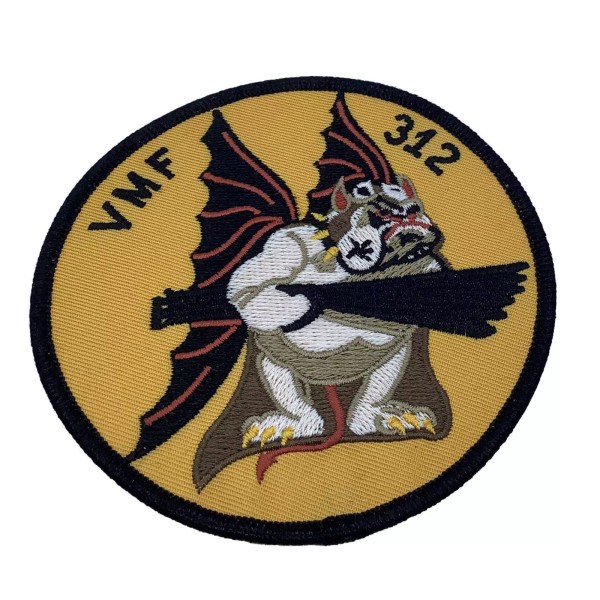


VMF-312 Checkerboards Patch- Plastic Backing
VMF-312 Checkerboards Patch- No Hook and Loop
A 4" No Hook and Loop Squadron Patch of the VMF-312 Checkerboards.
- 4" inches
- No Hook and Loop
- US Veteran Owned Business
Marine Fighter Attack Squadron 312 (VMFA-312) is a United States Marine Corps F/A-18C Hornet squadron. Also known as the "Checkerboards", the squadron is based at Marine Corps Air Station Beaufort, South Carolina and falls under the command of Marine Aircraft Group 31 (MAG-31) and the 2nd Marine Aircraft Wing (2nd MAW). The Radio Callsign is "Check."
History
World War II
Marine Fighter Squadron 312 (VMF-312) was commissioned on June 1, 1943, at Page Field, Parris Island, South Carolina. Originally it was part of MAG-31, 1st MAW. As first aircraft the squadron received 10 SNJ-4 Texans and one F4U-1A Corsair. As their unit crest the squadron members choose a satan-like bulldog wearing a flying helmet and carrying -at that time- six .50 caliber machineguns (the armament of the Corsair) drawn by Technical Sergeant James R. Wroble.[3] In honor of their commanding officer, Major Richard M. Day, the men nicknamed their squadron "Day's Knights". Also at this time, the Checkerboards emblem began to appear on both the cowling and rudder of the aircraft.
After being transferred in August 1943 to MAG-32, 3rd MAW, the squadron relocated to San Diego, California, and departed Parris Island on January 2, 1944, and headed for Miramar. They departed MCAS Miramar on February 28, 1944 and headed for Marine Corps Air Station Ewa on Hawai. VMF-312 trained at Ewa for 3 months and then headed out for Espiritu Santo, New Hebrides to become part of MAG-11, 2nd MAW.
Assigned to Marine Aircraft Group 11 on June 25, 1944, the squadron was transported to Espiritu Santo, New Hebrides, where they received 24 new F4U-1D Corsairs. VMF-312's first combat action came on April 12, 1945 during the Battle of Okinawa as part of Marine Aircraft Group 33 (MAG-33), when four squadron aircraft intercepted 20 Japanese Zeros and achieved eight kills without a loss. VMF-312 continued to operate from Kadena Air Base on Okinawa until the cessation of hostilities. By war's end, the squadron had accounted for 59.5 air combat kills in the Pacific Theater.
Between September 1945 and February 1946 VMF-312 participated in the occupation force stationed on Okinawa.
1946-1950
Returning to the United States in February 1946, the squadron began operations at Marine Corps Air Station El Toro still as part of MAG-33, where the squadron completed a transition to F7F-3 Tigercats, a single seat day fighter variant of the two seat Tigercat night fighter. Although the night fighters continued in service for several years, the day fighter version proved unsuitable, and VMF-312 transitioned back to Corsairs, this time F4U-4s, a higher performance model.[8]
The Korean War, 1950-1955
The squadron transferred to Marine Aircraft Group 12, MCAS El Toro in July 1950 and was alerted for deployment and service in the Korean War. The first VMF-312 aircraft flew in Korea on September 19, 1950. Flying out of Wonson Air Base, the Checkerboards flew missions in support of the 1st Marine Division during the Battle of Chosin Reservoir.[9] Redeployed in March 1951 aboard the light carrier USS Bataan (CVL-29), the Checkerboards were assigned escort and blockade missions.[10] Leaving the ship in June 1951, the squadron amassed 4,945 accident-free hours of carrier operations while logging 1,920 carrier landings. After a short period of ground-based close air support operations, the squadron returned to sea, first with Bairoko, then with Bataan, and later with Sicily.
While aboard Bataan, the Checkerboards became the first piston engine squadron to shoot down a jet aircraft, when Captain Jesse Folmar shot down a MiG-15 jet fighter with 20 mm cannon fire.[12] On June 8, 1953, the Checkerboards were relieved by VMF-332, and returned to the United States in anticipation of transitioning to F9F Panthers at Marine Corps Air Station Miami, Florida.
The 1960s through the 1990s
The Panthers were replaced with FJ-2 Furies (the naval version of the F-86 Sabre) and later FJ-3 Furies, while they in their turn were being replaced in mid-1959 by F8U-1 Crusaders. Concurrent with the reassignment in February 1966 to MCAS Beaufort was the transition to yet another aircraft, the F-4B Phantom II, and redesignation as Marine Fighter Attack Squadron (VMFA-312). Crewed with a pilot and Radar Intercept Officer, and capable of speeds of up to mach 2, the Phantom served as a formidable combat weapon with the Checkerboards for over 20 years.
During the Vietnam War, the Checkerboards performed the vital mission of training combat aircrews prior to their deployment to Southeast Asia. In 1973, the squadron received the newer F-4J aircraft, with its much improved radar and avionics, as well as improved aerodynamic design.
In 1979, the Checkerboards became the first 2nd Marine Aircraft Wing fighter squadron to deploy to the Western Pacific under the Unit Deployment Program (UDP). Since joining the UDP cycle, VMFA-312 has made five six-month deployments to the Western Pacific as well as participated in numerous training deployments around the United States. Upon completion of the first six-month UDP rotation, the Checkerboards became the first squadron to receive the F-4S variant of the Phantom, which incorporated leading edge slats as well as advanced radar. In July 1987, VMFA-312 retired its F-4 aircraft and transitioned to the F/A-18A Hornet.
In 1993, VMFA-312 participated in Operation Provide Promise and Operation Deny Flight over Yugoslavia. They also flew missions over Iraq in support of Operation Southern Watch while operating from the Red Sea.
In March 1995, the squadron deployed once again with Carrier Air Wing 8 aboard Theodore Roosevelt for its second consecutive Mediterranean deployment. During the cruise, VMFA-312 participated in Operations Southern Watch from the Red Sea and Persian Gulf, then Operation Sharp Guard and Operation Deny Flight from the Adriatic Sea.
In late August and September 1995, the Checkerboards conducted their first direct combat sorties since Vietnam in support of the United Nations resolutions in Operation Deliberate Force. NATO's decision to conduct immediate air strikes against Bosnian-Serb ammunition bunkers, communication and control facilities, and logistical storage buildings heavily tasked both the air wing and the Checkerboards.
The Checkerboards along with CVW-3 began missions in support of Operation Southern Watch, on November 27, 1998. The mission would change as the order came down to commence Operation Desert Fox, December 16, 1998. The air campaign lasted four nights and would end with the following: (1) 100% sortie completion rate, (2) 44 combat night sorties, (3) 120.2 combat hours, (4) 74% of assigned targets destroyed, (5) 27 HARM fired, 53 LGB's dropped, the first combat deployment of the AGM-154 JSOW and (6) over 95,500 lb of ordnance loaded. In the four nights of operations, the "Checkerboards" had zero injuries or casualties.
Carrier Air Wing Three entered the North Persian Gulf and began Operation Southern Watch missions on January 3, 2001. Nearly two weeks later, the Checkerboards were proud to christen Harry S. Truman with her first combat engagement. On January 20, a VMFA-312 jet destroyed an anti-aircraft artillery site, which was threatening coalition aircraft in Southern Iraq. On February 16, five VMFA-312 aircraft participated in a large force strike against numerous targets in the vicinity of Baghdad.
Global War on Terror
The Checkerboards deployed aboard Enterprise in August 2003. They arrived in the Persian Gulf in October and began support of Operation Iraqi Freedom (OIF). In November, VMFA-312 became the first squadron in the carrier air-wing to release ordnance in support of OIF. The Checkerboards remained in their area of operations until the end of January before transiting towards home.
| Isin: | IIKRYYYSAWKY |
|---|
Out of Stock
In Stock
Backordered
Out of Stock



IBspot Buyer Protection
Shop confidently on IBspot, receive your item as described or your money back for eligible orders. Learn Program Terms
GUARANTEED SAFE CHECKOUT
-

MONEY BACK GUARANTEE
30 days money back guarantee, no additional fee charged.
-

EXCELLENT SUPPORT
We provide 24/7 online customer support via email.
-

Fast Shipping
One week domestic shipping. Global delivery to the US in 2 weeks.
VMF-312 Checkerboards Patch- No Hook and Loop
A 4" No Hook and Loop Squadron Patch of the VMF-312 Checkerboards.
- 4" inches
- No Hook and Loop
- US Veteran Owned Business
Marine Fighter Attack Squadron 312 (VMFA-312) is a United States Marine Corps F/A-18C Hornet squadron. Also known as the "Checkerboards", the squadron is based at Marine Corps Air Station Beaufort, South Carolina and falls under the command of Marine Aircraft Group 31 (MAG-31) and the 2nd Marine Aircraft Wing (2nd MAW). The Radio Callsign is "Check."
History
World War II
Marine Fighter Squadron 312 (VMF-312) was commissioned on June 1, 1943, at Page Field, Parris Island, South Carolina. Originally it was part of MAG-31, 1st MAW. As first aircraft the squadron received 10 SNJ-4 Texans and one F4U-1A Corsair. As their unit crest the squadron members choose a satan-like bulldog wearing a flying helmet and carrying -at that time- six .50 caliber machineguns (the armament of the Corsair) drawn by Technical Sergeant James R. Wroble.[3] In honor of their commanding officer, Major Richard M. Day, the men nicknamed their squadron "Day's Knights". Also at this time, the Checkerboards emblem began to appear on both the cowling and rudder of the aircraft.
After being transferred in August 1943 to MAG-32, 3rd MAW, the squadron relocated to San Diego, California, and departed Parris Island on January 2, 1944, and headed for Miramar. They departed MCAS Miramar on February 28, 1944 and headed for Marine Corps Air Station Ewa on Hawai. VMF-312 trained at Ewa for 3 months and then headed out for Espiritu Santo, New Hebrides to become part of MAG-11, 2nd MAW.
Assigned to Marine Aircraft Group 11 on June 25, 1944, the squadron was transported to Espiritu Santo, New Hebrides, where they received 24 new F4U-1D Corsairs. VMF-312's first combat action came on April 12, 1945 during the Battle of Okinawa as part of Marine Aircraft Group 33 (MAG-33), when four squadron aircraft intercepted 20 Japanese Zeros and achieved eight kills without a loss. VMF-312 continued to operate from Kadena Air Base on Okinawa until the cessation of hostilities. By war's end, the squadron had accounted for 59.5 air combat kills in the Pacific Theater.
Between September 1945 and February 1946 VMF-312 participated in the occupation force stationed on Okinawa.
1946-1950
Returning to the United States in February 1946, the squadron began operations at Marine Corps Air Station El Toro still as part of MAG-33, where the squadron completed a transition to F7F-3 Tigercats, a single seat day fighter variant of the two seat Tigercat night fighter. Although the night fighters continued in service for several years, the day fighter version proved unsuitable, and VMF-312 transitioned back to Corsairs, this time F4U-4s, a higher performance model.[8]
The Korean War, 1950-1955
The squadron transferred to Marine Aircraft Group 12, MCAS El Toro in July 1950 and was alerted for deployment and service in the Korean War. The first VMF-312 aircraft flew in Korea on September 19, 1950. Flying out of Wonson Air Base, the Checkerboards flew missions in support of the 1st Marine Division during the Battle of Chosin Reservoir.[9] Redeployed in March 1951 aboard the light carrier USS Bataan (CVL-29), the Checkerboards were assigned escort and blockade missions.[10] Leaving the ship in June 1951, the squadron amassed 4,945 accident-free hours of carrier operations while logging 1,920 carrier landings. After a short period of ground-based close air support operations, the squadron returned to sea, first with Bairoko, then with Bataan, and later with Sicily.
While aboard Bataan, the Checkerboards became the first piston engine squadron to shoot down a jet aircraft, when Captain Jesse Folmar shot down a MiG-15 jet fighter with 20 mm cannon fire.[12] On June 8, 1953, the Checkerboards were relieved by VMF-332, and returned to the United States in anticipation of transitioning to F9F Panthers at Marine Corps Air Station Miami, Florida.
The 1960s through the 1990s
The Panthers were replaced with FJ-2 Furies (the naval version of the F-86 Sabre) and later FJ-3 Furies, while they in their turn were being replaced in mid-1959 by F8U-1 Crusaders. Concurrent with the reassignment in February 1966 to MCAS Beaufort was the transition to yet another aircraft, the F-4B Phantom II, and redesignation as Marine Fighter Attack Squadron (VMFA-312). Crewed with a pilot and Radar Intercept Officer, and capable of speeds of up to mach 2, the Phantom served as a formidable combat weapon with the Checkerboards for over 20 years.
During the Vietnam War, the Checkerboards performed the vital mission of training combat aircrews prior to their deployment to Southeast Asia. In 1973, the squadron received the newer F-4J aircraft, with its much improved radar and avionics, as well as improved aerodynamic design.
In 1979, the Checkerboards became the first 2nd Marine Aircraft Wing fighter squadron to deploy to the Western Pacific under the Unit Deployment Program (UDP). Since joining the UDP cycle, VMFA-312 has made five six-month deployments to the Western Pacific as well as participated in numerous training deployments around the United States. Upon completion of the first six-month UDP rotation, the Checkerboards became the first squadron to receive the F-4S variant of the Phantom, which incorporated leading edge slats as well as advanced radar. In July 1987, VMFA-312 retired its F-4 aircraft and transitioned to the F/A-18A Hornet.
In 1993, VMFA-312 participated in Operation Provide Promise and Operation Deny Flight over Yugoslavia. They also flew missions over Iraq in support of Operation Southern Watch while operating from the Red Sea.
In March 1995, the squadron deployed once again with Carrier Air Wing 8 aboard Theodore Roosevelt for its second consecutive Mediterranean deployment. During the cruise, VMFA-312 participated in Operations Southern Watch from the Red Sea and Persian Gulf, then Operation Sharp Guard and Operation Deny Flight from the Adriatic Sea.
In late August and September 1995, the Checkerboards conducted their first direct combat sorties since Vietnam in support of the United Nations resolutions in Operation Deliberate Force. NATO's decision to conduct immediate air strikes against Bosnian-Serb ammunition bunkers, communication and control facilities, and logistical storage buildings heavily tasked both the air wing and the Checkerboards.
The Checkerboards along with CVW-3 began missions in support of Operation Southern Watch, on November 27, 1998. The mission would change as the order came down to commence Operation Desert Fox, December 16, 1998. The air campaign lasted four nights and would end with the following: (1) 100% sortie completion rate, (2) 44 combat night sorties, (3) 120.2 combat hours, (4) 74% of assigned targets destroyed, (5) 27 HARM fired, 53 LGB's dropped, the first combat deployment of the AGM-154 JSOW and (6) over 95,500 lb of ordnance loaded. In the four nights of operations, the "Checkerboards" had zero injuries or casualties.
Carrier Air Wing Three entered the North Persian Gulf and began Operation Southern Watch missions on January 3, 2001. Nearly two weeks later, the Checkerboards were proud to christen Harry S. Truman with her first combat engagement. On January 20, a VMFA-312 jet destroyed an anti-aircraft artillery site, which was threatening coalition aircraft in Southern Iraq. On February 16, five VMFA-312 aircraft participated in a large force strike against numerous targets in the vicinity of Baghdad.
Global War on Terror
The Checkerboards deployed aboard Enterprise in August 2003. They arrived in the Persian Gulf in October and began support of Operation Iraqi Freedom (OIF). In November, VMFA-312 became the first squadron in the carrier air-wing to release ordnance in support of OIF. The Checkerboards remained in their area of operations until the end of January before transiting towards home.
Processing Time
- We process and ship orders Monday through Friday, excluding holidays.
- Most orders are processed within 1–3 business days, depending on product availability.
- Processing time does not include delivery time, which varies based on your location and the product’s shipping origin.
Shipping Coverage
We currently ship to addresses within the United States only.
Products may ship from:
- Our U.S. warehouses, or
- Our international fulfillment centers (including Korea, Japan, China, Australia, Mexico, Canada, the United Kingdom, and the EU).
Each product page clearly displays the “Ships From” location before checkout.
Shipping Methods & Estimated Delivery
| Shipping Method | Estimated Delivery | Cost |
|---|---|---|
| Free Shipping (US) | 5–10 business days | Free, available on eligible items |
| Standard Shipping (US to US by Item) | 5–10 business days | $6.50 for the first item, $2.00 each additional |
| Standard Shipping (From US Warehouse by Weight) | 3–7 business days | Starts at $6.50, increasing by $2 for every additional 4 oz (0.25 lb) up to 1 lb, then by $4 for each additional pound beyond 1 lb. |
| Extended Delivery (Ships from Overseas Warehouse) | 10–20 business days | $14.50 for the first item, $2.00 each additional |
Shipping costs vary by product weight, quantity and origin. Exact rates and delivery estimates are displayed on each product page and confirmed during checkout.
Free Shipping
We offer free standard shipping on select products or during promotional periods. Availability of free shipping will be displayed on the product page and at checkout.
Carriers
We primarily use USPS and UPS for U.S. deliveries. Items shipped from international warehouses may be handled by partner carriers depending on the country of origin.
Import Duties & Taxes
All import duties and taxes for goods imported into the United States are included in the product price. There are no hidden fees or additional charges at checkout.
Tracking & Notifications
Every order is fully trackable. You will receive a tracking number via email once your order ships. If your order ships in multiple packages, each package will have its own tracking number. If you don’t receive a shipping confirmation immediately, your order is still being processed and will arrive within the estimated timeframe shown at checkout.
You can track your shipment anytime using the Track Your Order page on our website.
Order Changes & Cancellations
If you need to modify or cancel an order, please contact our customer support team as soon as possible. Orders can only be canceled before they ship. Once shipped, cancellations are not possible, but you may request a return after the item is delivered.
Contact: support@ibspot.com
Item Not Received
If your tracking number shows “Delivered” but you haven’t received your package:
- Check with your local USPS or UPS office.
- Confirm that the shipping address provided was correct.
- If the issue remains unresolved, contact support@ibspot.com for assistance.
Damaged or Lost Parcels
If your package arrives damaged or fails to arrive, please contact us immediately. For deliveries to P.O. boxes, ibspot is not responsible for damage caused by weather, temperature, or theft.
Customer Support
For any questions about shipping, tracking, or delivery, our customer support team is here to help.
Email: support@ibspot.com
We’re always happy to help.
Please read our policy carefully before making a purchase.
We aim to ensure every customer has a smooth and transparent experience with ibspot.com.
Order Cancellation Policy
Customers may request to cancel an order before it has been shipped.
Once the package has been shipped, cancellations are no longer possible; however, you may still request a return after receiving your order.
How to Request a Cancellation
You can contact us through:
- Email: support@ibspot.com
- Contact Form: Submit a request through our Contact Us page
Please submit your cancellation request as soon as possible after placing the order to allow us to process it before shipment.
Return Policy
We accept returns for most items within 30 days of delivery for a full refund.
To be eligible for a return:
- The item must be unused, in the same condition as received, and in its original packaging.
- A tracking number must be provided to confirm the return shipment.
Non-Returnable Items
Certain products cannot be returned, including:
- Perishable goods (for example, food, flowers, newspapers, magazines)
- Intimate or sanitary goods
- Hazardous materials or flammable liquids/gases
- Gift cards
- Downloadable software
- Some health and personal care items
Partial Refunds (If Applicable)
Partial refunds may be granted in specific situations, such as:
- Books with obvious signs of use
- Opened CDs, DVDs, software, or vinyl records
- Items not in their original condition, damaged, or missing parts not due to our error
- Items returned more than 30 days after delivery
How to Return an Item
To initiate a return, please contact us at support@ibspot.com with your order number and details about the product you wish to return.
Our team will provide you with return instructions and a prepaid return label.
Shipping Cost for Returns
Please contact us before returning any item.
We will provide a free return shipping label.
If a return is sent back without prior contact or without our provided label, we cannot be held responsible for return shipping costs.
For items valued over $75, we recommend using a trackable shipping service or purchasing shipping insurance.
We cannot guarantee that we will receive your returned item if shipped independently.
Refund Processing
Once your return is received and inspected:
- In-store returns are refunded to the original form of payment or issued as a gift card.
- Mail-in returns using our prepaid label are refunded to the original payment method within 3–5 business days after we receive your return.
Please allow:
- 5–7 business days for the return to reach our Returns Center.
- An additional 3–10 business days for your bank to post the refund to your account.
Damages, Issues & Claims
Please inspect your order immediately upon receipt.
If you receive a defective, damaged, or incorrect item, contact us right away at support@ibspot.com.
We’ll evaluate the issue promptly and make it right.
Product Claims
Before purchasing, please review product details carefully.
If there is a problem with your order upon arrival, visit our Support Center or contact us directly to arrange return shipping or replacement.
Exchanges
We do not process direct exchanges.
The fastest way to get what you need is to return the original item and place a new order once your return is accepted.
Return Address
IBSPOT Return Center
15 Sawmill Ln
Dover Plains, NY 12522
United States
Customer Support
Our support team is available 24/7 to assist with cancellations, returns, or general inquiries.
Email: support@ibspot.com
Contact Form: Contact Us page

Oops!
Sorry, it looks like some products are not available in selected quantity.