

Willys Station Wagon - 1951 American Suburbia Vintage Advertising Poster
Willys Station Wagon - 1951 American Suburbia Vintage Advertising Poster




Willys Station Wagon - 1951 American Suburbia Vintage Advertising Poster
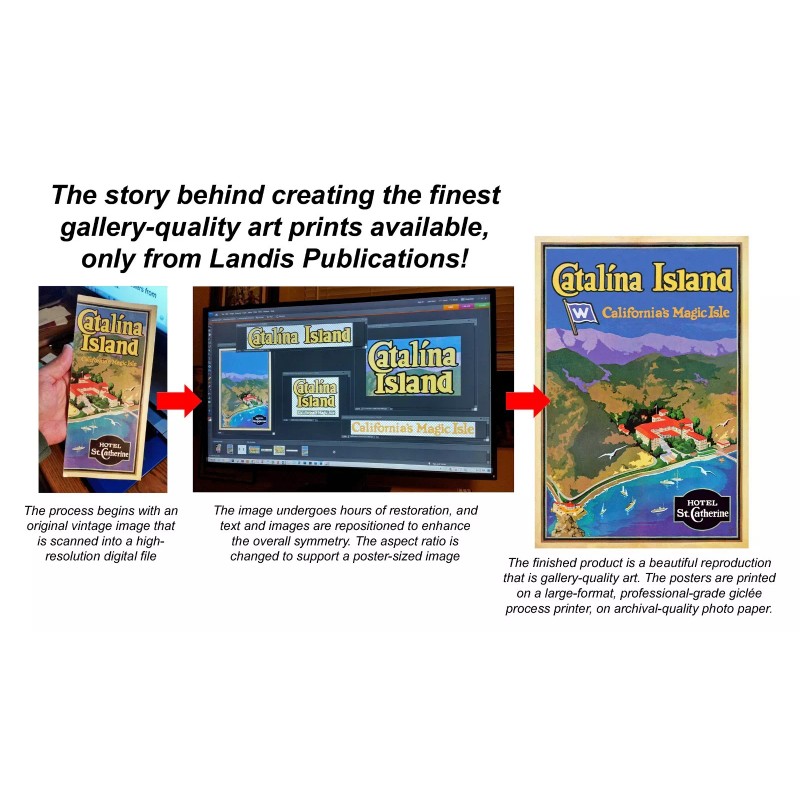
These are simply the best posters available! You will be thrilled with the image quality, vivid colors, fine paper, and unique subjects. This is an original image that has been transformed into a beautiful poster - available exclusively from Landis Publications.
This beautiful reproduction poster has been re-mastered from a 1951 advertisement for the Willys station wagon featuring a classic image of American suburbia.
The vibrant colors and detail of this classic image have been painstakingly brought back to life to preserve a great piece of history.
The high-resolution image is printed on heavy archival photo paper, on a large-format, professional giclée process printer. The poster is shipped in a rigid cardboard tube, and is ready for framing.
The 13"x19" format is an excellent image size that looks great as a stand-alone piece of art, or as a grouped visual statement. These posters require no cutting, trimming, or custom framing, and a wide variety of 13"x19" frames are readily available at your local craft or hobby retailer, and online.
A great vintage print for your home, shop, or business!
HISTORY OF WILLY’S JEEP STATION WAGON
Successor: Jeep Wagoneer
The Willys Jeep Station Wagon, Jeep Utility Wagon, and Jeep Panel Delivery, were produced by Willys in the United States, from 1946 to 1965. Production in Argentina and Brazil continued until 1970 and 1977, respectively. They were the first mass-market, all-steel station wagons designed and built as a passenger vehicle.
With over 300,000 wagons and its variants built in the U.S., it was one of Willys' most successful post-World War II models. Its production coincided with consumers moving to the suburbs.
The Jeep Station Wagon was assembled in several international markets under various forms of joint ventures, licenses, or knock-down kits.
Development and Reception
The Jeep Station Wagon was designed in the mid-1940s by industrial designer Brooks Stevens. Willys did not make their own bodies, car bodies were in high demand, and Willys was known to have limited finances. Brooks therefore designed bodies that could be built by sheet metal fabricators who normally made parts for household appliances and could draw sheet metal no more than 6 inches (152 mm). The Wagon's all-steel body was sometimes painted to resemble a woody.
The steel body was efficient to mass-produce, easier to maintain, and safer than the real wood-bodied station wagon versions of the time. Within the first two years of the Jeep Wagon's production, the only manufacturer in the United States with a station wagon that was comparable in price was Crosley, who introduced an all-steel wagon in 1947.
The Jeep Station Wagon was the first Willys product with independent front suspension. Barney Roos, Willys' chief engineer, developed a system based on a transverse seven-leaf spring. The system, called "Planadyne" by Willys, was similar in concept to the "planar" suspension Roos had developed for Studebaker in the mid-1930s.
For some time after the 1949 introduction of a four-wheel-drive option, the 2WD was sold as "Station Wagon", while the 4WD was marketed as "Utility Wagon." The 4WD Willys Jeep Wagon is often considered the first production sport utility vehicle.
Production timeline
Willys Jeep "Estanciera" made by IKA in Argentina.
Brazil – Willys Wagon became the Ford Rural (1969-1974 model)
Willys Jeep Station Wagon taxi, Cuba.
USA
1946: introduced as the 463, powered by the L-134 Go-Devil flathead inline-four engine.
1947: a panel van introduced with one seat, a pair of doors instead of the wagon's tailgate, and no side windows behind the front doors.
1948: introduction of the 663, powered by the L-148 Lightning straight-six engine. A luxury version, the Station Sedan, had solid body colors with basket-weave trim on the sides and was better finished than the wagon throughout.
1949: four-wheel-drive became an option.
1950: the flat grille was replaced by a pointed v-shape design with five horizontal bars across the vertical ones. The 473 model got the new 'F-134 Hurricane, and the 673 model got a new 161 cu in (2.6 L) version of the Lightning six. Station sedan discontinued.
1952: the flathead Lightning was dropped in favor of the F-161 Hurricane, installed in the 685 model.
1954: the first under Kaiser's ownership. The 6-226 Super Hurricane, a flathead inline six, was introduced. This was a version of the Kaiser Supersonic/Continental Red Seal engine and became available on four-wheel drive versions in 1954. Minor revisions were made to front end styling that year, including the reduction of the number of horizontal slats in the grille from five
to three. There were few other changes between 1953 and 1955.
1955: A number of new models were added. The 6-226 model lineup gained stripped chassis, flat face cowl, cowl/windshield, and ambulance models. The 475 line received only the cowl/windshield. Willys withdrew from the passenger car market and renamed the vehicle the Utility Wagon. The seventh seat and the overdrive were deleted, and the Planadyne front suspension used with the two-wheel drive wagon was replaced with a beam axle. Warn hubs, with which the front drive mechanism could be disengaged by turning the hubs by hand, became optional on four-wheel drive models.
1958: The Maverick model introduced, a more luxurious version of the two-wheel drive wagon.
It could be had only with the four-cylinder engine. The main upgrades were in the introduction of two-tone paint with matching interior in two tones and the standard AM radio. It was distinguished by its extra stainless steel trim ring under the windows. The Maverick name came from the TV series of the same name, of which Willys was a sponsor.
1962: the 6-230 Tornado OHC engine was introduced midyear, replacing the flathead.
1965: production ends as the Willys model had been phased out by the Jeep Wagoneer.
| Isin: | IM3C9JLVUSEF |
|---|
Out of Stock
In Stock
Backordered
Out of Stock



IBspot Buyer Protection
Shop confidently on IBspot, receive your item as described or your money back for eligible orders. Learn Program Terms
GUARANTEED SAFE CHECKOUT
-

MONEY BACK GUARANTEE
30 days money back guarantee, no additional fee charged.
-

EXCELLENT SUPPORT
We provide 24/7 online customer support via email.
-

Fast Shipping
One week domestic shipping. Global delivery to the US in 2 weeks.
These are simply the best posters available! You will be thrilled with the image quality, vivid colors, fine paper, and unique subjects. This is an original image that has been transformed into a beautiful poster - available exclusively from Landis Publications.
This beautiful reproduction poster has been re-mastered from a 1951 advertisement for the Willys station wagon featuring a classic image of American suburbia.
The vibrant colors and detail of this classic image have been painstakingly brought back to life to preserve a great piece of history.
The high-resolution image is printed on heavy archival photo paper, on a large-format, professional giclée process printer. The poster is shipped in a rigid cardboard tube, and is ready for framing.
The 13"x19" format is an excellent image size that looks great as a stand-alone piece of art, or as a grouped visual statement. These posters require no cutting, trimming, or custom framing, and a wide variety of 13"x19" frames are readily available at your local craft or hobby retailer, and online.
A great vintage print for your home, shop, or business!
HISTORY OF WILLY’S JEEP STATION WAGON
Successor: Jeep Wagoneer
The Willys Jeep Station Wagon, Jeep Utility Wagon, and Jeep Panel Delivery, were produced by Willys in the United States, from 1946 to 1965. Production in Argentina and Brazil continued until 1970 and 1977, respectively. They were the first mass-market, all-steel station wagons designed and built as a passenger vehicle.
With over 300,000 wagons and its variants built in the U.S., it was one of Willys' most successful post-World War II models. Its production coincided with consumers moving to the suburbs.
The Jeep Station Wagon was assembled in several international markets under various forms of joint ventures, licenses, or knock-down kits.
Development and Reception
The Jeep Station Wagon was designed in the mid-1940s by industrial designer Brooks Stevens. Willys did not make their own bodies, car bodies were in high demand, and Willys was known to have limited finances. Brooks therefore designed bodies that could be built by sheet metal fabricators who normally made parts for household appliances and could draw sheet metal no more than 6 inches (152 mm). The Wagon's all-steel body was sometimes painted to resemble a woody.
The steel body was efficient to mass-produce, easier to maintain, and safer than the real wood-bodied station wagon versions of the time. Within the first two years of the Jeep Wagon's production, the only manufacturer in the United States with a station wagon that was comparable in price was Crosley, who introduced an all-steel wagon in 1947.
The Jeep Station Wagon was the first Willys product with independent front suspension. Barney Roos, Willys' chief engineer, developed a system based on a transverse seven-leaf spring. The system, called "Planadyne" by Willys, was similar in concept to the "planar" suspension Roos had developed for Studebaker in the mid-1930s.
For some time after the 1949 introduction of a four-wheel-drive option, the 2WD was sold as "Station Wagon", while the 4WD was marketed as "Utility Wagon." The 4WD Willys Jeep Wagon is often considered the first production sport utility vehicle.
Production timeline
Willys Jeep "Estanciera" made by IKA in Argentina.
Brazil – Willys Wagon became the Ford Rural (1969-1974 model)
Willys Jeep Station Wagon taxi, Cuba.
USA
1946: introduced as the 463, powered by the L-134 Go-Devil flathead inline-four engine.
1947: a panel van introduced with one seat, a pair of doors instead of the wagon's tailgate, and no side windows behind the front doors.
1948: introduction of the 663, powered by the L-148 Lightning straight-six engine. A luxury version, the Station Sedan, had solid body colors with basket-weave trim on the sides and was better finished than the wagon throughout.
1949: four-wheel-drive became an option.
1950: the flat grille was replaced by a pointed v-shape design with five horizontal bars across the vertical ones. The 473 model got the new 'F-134 Hurricane, and the 673 model got a new 161 cu in (2.6 L) version of the Lightning six. Station sedan discontinued.
1952: the flathead Lightning was dropped in favor of the F-161 Hurricane, installed in the 685 model.
1954: the first under Kaiser's ownership. The 6-226 Super Hurricane, a flathead inline six, was introduced. This was a version of the Kaiser Supersonic/Continental Red Seal engine and became available on four-wheel drive versions in 1954. Minor revisions were made to front end styling that year, including the reduction of the number of horizontal slats in the grille from five
to three. There were few other changes between 1953 and 1955.
1955: A number of new models were added. The 6-226 model lineup gained stripped chassis, flat face cowl, cowl/windshield, and ambulance models. The 475 line received only the cowl/windshield. Willys withdrew from the passenger car market and renamed the vehicle the Utility Wagon. The seventh seat and the overdrive were deleted, and the Planadyne front suspension used with the two-wheel drive wagon was replaced with a beam axle. Warn hubs, with which the front drive mechanism could be disengaged by turning the hubs by hand, became optional on four-wheel drive models.
1958: The Maverick model introduced, a more luxurious version of the two-wheel drive wagon.
It could be had only with the four-cylinder engine. The main upgrades were in the introduction of two-tone paint with matching interior in two tones and the standard AM radio. It was distinguished by its extra stainless steel trim ring under the windows. The Maverick name came from the TV series of the same name, of which Willys was a sponsor.
1962: the 6-230 Tornado OHC engine was introduced midyear, replacing the flathead.
1965: production ends as the Willys model had been phased out by the Jeep Wagoneer.
- Type of Advertising: Poster
- Model: Station Wagon
- Country/Region of Manufacture: United States
- Original/Reproduction: Reproduction
- Make: Jeep, Willys
- Date of Origin: 1951
Processing Time
- We process and ship orders Monday through Friday, excluding holidays.
- Most orders are processed within 1–3 business days, depending on product availability.
- Processing time does not include delivery time, which varies based on your location and the product’s shipping origin.
Shipping Coverage
We currently ship to addresses within the United States only.
Products may ship from:
- Our U.S. warehouses, or
- Our international fulfillment centers (including Korea, Japan, China, Australia, Mexico, Canada, the United Kingdom, and the EU).
Each product page clearly displays the “Ships From” location before checkout.
Shipping Methods & Estimated Delivery
| Shipping Method | Estimated Delivery | Cost |
|---|---|---|
| Free Shipping (US) | 5–10 business days | Free, available on eligible items |
| Standard Shipping (US to US by Item) | 5–10 business days | $6.50 for the first item, $2.00 each additional |
| Standard Shipping (From US Warehouse by Weight) | 3–7 business days | Starts at $6.50, increasing by $2 for every additional 4 oz (0.25 lb) up to 1 lb, then by $4 for each additional pound beyond 1 lb. |
| Extended Delivery (Ships from Overseas Warehouse) | 10–20 business days | $14.50 for the first item, $2.00 each additional |
Shipping costs vary by product weight, quantity and origin. Exact rates and delivery estimates are displayed on each product page and confirmed during checkout.
Free Shipping
We offer free standard shipping on select products or during promotional periods. Availability of free shipping will be displayed on the product page and at checkout.
Carriers
We primarily use USPS and UPS for U.S. deliveries. Items shipped from international warehouses may be handled by partner carriers depending on the country of origin.
Import Duties & Taxes
All import duties and taxes for goods imported into the United States are included in the product price. There are no hidden fees or additional charges at checkout.
Tracking & Notifications
Every order is fully trackable. You will receive a tracking number via email once your order ships. If your order ships in multiple packages, each package will have its own tracking number. If you don’t receive a shipping confirmation immediately, your order is still being processed and will arrive within the estimated timeframe shown at checkout.
You can track your shipment anytime using the Track Your Order page on our website.
Order Changes & Cancellations
If you need to modify or cancel an order, please contact our customer support team as soon as possible. Orders can only be canceled before they ship. Once shipped, cancellations are not possible, but you may request a return after the item is delivered.
Contact: support@ibspot.com
Item Not Received
If your tracking number shows “Delivered” but you haven’t received your package:
- Check with your local USPS or UPS office.
- Confirm that the shipping address provided was correct.
- If the issue remains unresolved, contact support@ibspot.com for assistance.
Damaged or Lost Parcels
If your package arrives damaged or fails to arrive, please contact us immediately. For deliveries to P.O. boxes, ibspot is not responsible for damage caused by weather, temperature, or theft.
Customer Support
For any questions about shipping, tracking, or delivery, our customer support team is here to help.
Email: support@ibspot.com
We’re always happy to help.
Please read our policy carefully before making a purchase.
We aim to ensure every customer has a smooth and transparent experience with ibspot.com.
Order Cancellation Policy
Customers may request to cancel an order before it has been shipped.
Once the package has been shipped, cancellations are no longer possible; however, you may still request a return after receiving your order.
How to Request a Cancellation
You can contact us through:
- Email: support@ibspot.com
- Contact Form: Submit a request through our Contact Us page
Please submit your cancellation request as soon as possible after placing the order to allow us to process it before shipment.
Return Policy
We accept returns for most items within 30 days of delivery for a full refund.
To be eligible for a return:
- The item must be unused, in the same condition as received, and in its original packaging.
- A tracking number must be provided to confirm the return shipment.
Non-Returnable Items
Certain products cannot be returned, including:
- Perishable goods (for example, food, flowers, newspapers, magazines)
- Intimate or sanitary goods
- Hazardous materials or flammable liquids/gases
- Gift cards
- Downloadable software
- Some health and personal care items
Partial Refunds (If Applicable)
Partial refunds may be granted in specific situations, such as:
- Books with obvious signs of use
- Opened CDs, DVDs, software, or vinyl records
- Items not in their original condition, damaged, or missing parts not due to our error
- Items returned more than 30 days after delivery
How to Return an Item
To initiate a return, please contact us at support@ibspot.com with your order number and details about the product you wish to return.
Our team will provide you with return instructions and a prepaid return label.
Shipping Cost for Returns
Please contact us before returning any item.
We will provide a free return shipping label.
If a return is sent back without prior contact or without our provided label, we cannot be held responsible for return shipping costs.
For items valued over $75, we recommend using a trackable shipping service or purchasing shipping insurance.
We cannot guarantee that we will receive your returned item if shipped independently.
Refund Processing
Once your return is received and inspected:
- In-store returns are refunded to the original form of payment or issued as a gift card.
- Mail-in returns using our prepaid label are refunded to the original payment method within 3–5 business days after we receive your return.
Please allow:
- 5–7 business days for the return to reach our Returns Center.
- An additional 3–10 business days for your bank to post the refund to your account.
Damages, Issues & Claims
Please inspect your order immediately upon receipt.
If you receive a defective, damaged, or incorrect item, contact us right away at support@ibspot.com.
We’ll evaluate the issue promptly and make it right.
Product Claims
Before purchasing, please review product details carefully.
If there is a problem with your order upon arrival, visit our Support Center or contact us directly to arrange return shipping or replacement.
Exchanges
We do not process direct exchanges.
The fastest way to get what you need is to return the original item and place a new order once your return is accepted.
Return Address
IBSPOT Return Center
15 Sawmill Ln
Dover Plains, NY 12522
United States
Customer Support
Our support team is available 24/7 to assist with cancellations, returns, or general inquiries.
Email: support@ibspot.com
Contact Form: Contact Us page

Oops!
Sorry, it looks like some products are not available in selected quantity.